
Proposition P: What Kearney Voters Are Being Asked to Decide |
The Nov. 3 measure would add a half-cent citywide sales tax for public safety, with revenue restricted to improving public safety in Kearney |
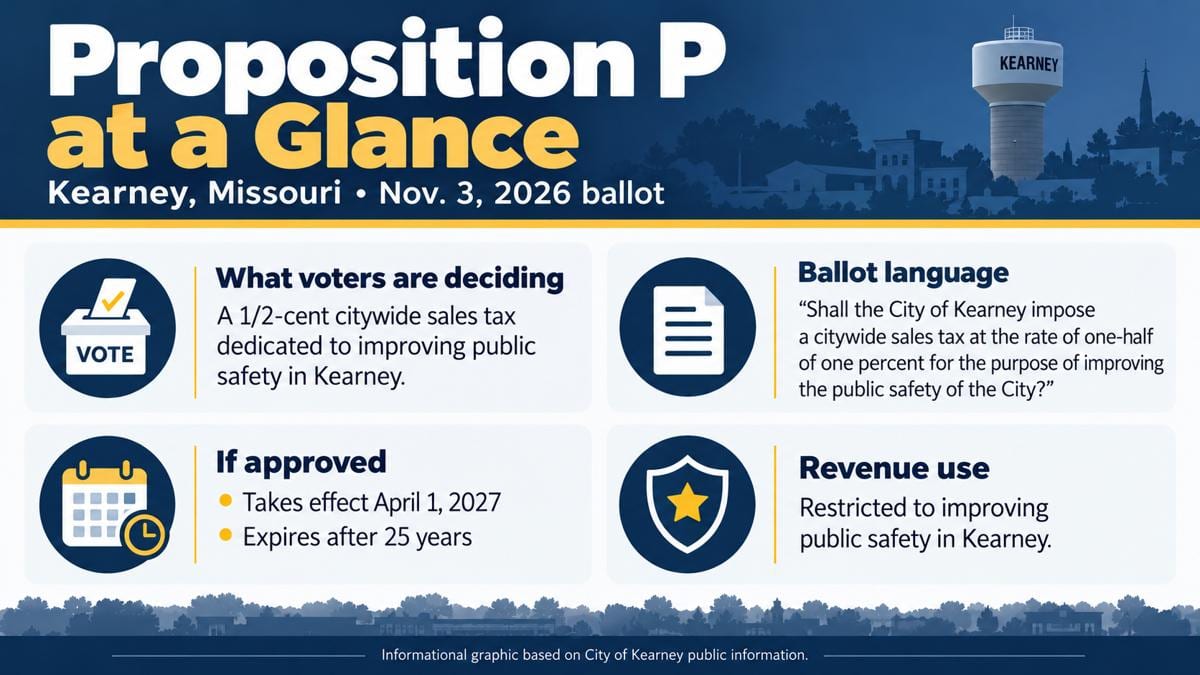
Kearney voters will decide Proposition P on November 3, a ballot measure asking whether the city should impose a one-half-cent sales tax dedicated to improving public safety.
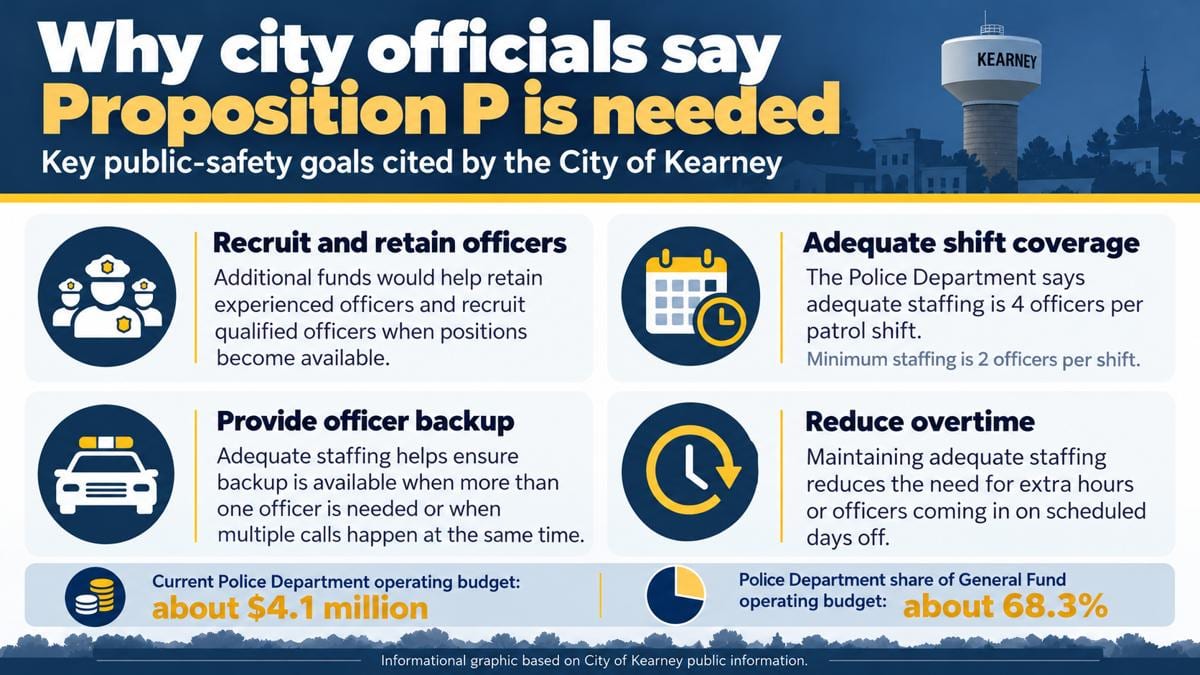
The measure is focused primarily on police staffing, officer recruitment and retention, maintaining adequate patrol coverage, providing backup on calls, and reducing reliance on overtime.
What the ballot actually says
The ballot question asks whether the City of Kearney should impose a citywide sales tax of one-half of one percent for the purpose of improving public safety.
If approved, the tax would take effect April 1, 2027, and would expire after 25 years.
The revenue would be legally restricted to public-safety purposes rather than becoming unrestricted money for any city use.
What a half-cent sales tax means at the register
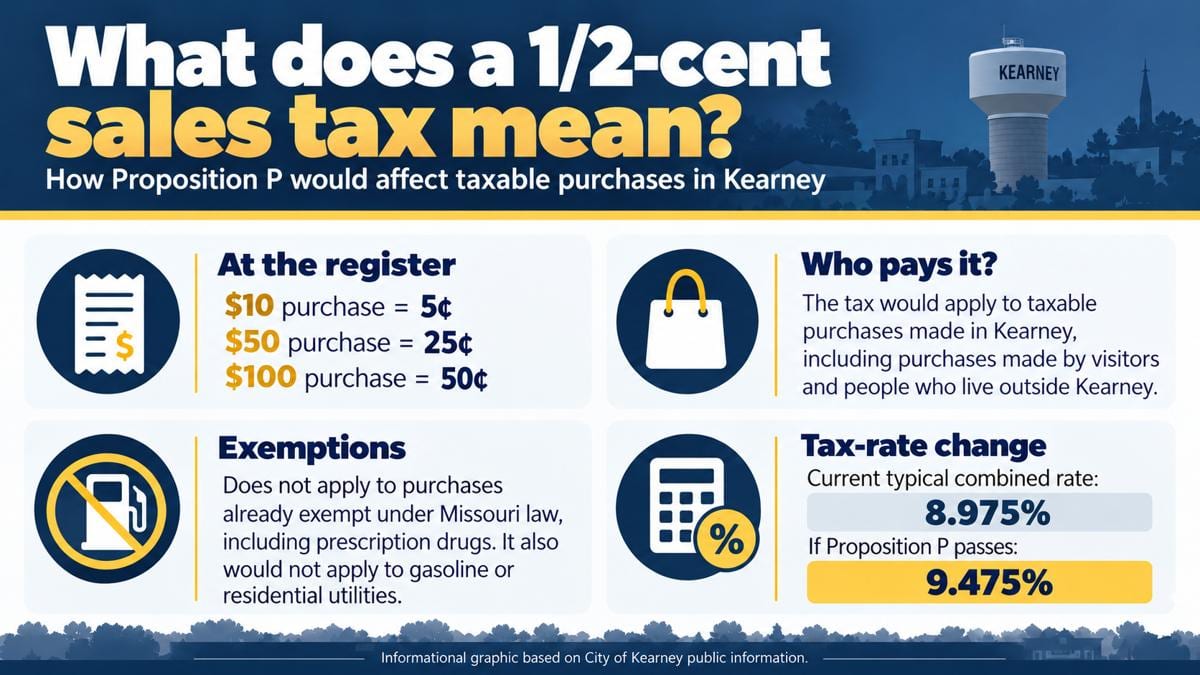
A one-half-cent tax adds 50 cents to a $100 taxable purchase, 25 cents to a $50 taxable purchase, and 5 cents to a $10 taxable purchase.
The tax would apply to taxable purchases made inside Kearney, including purchases by people who live outside the city.
It would not apply to purchases already exempt from sales tax under Missouri law, and the City says it also would not apply to gasoline, prescription drugs, or residential utilities.
The current combined citywide sales-tax rate is 8.975 percent; if Proposition P passes, the typical combined rate would rise to 9.475 percent.
|
 Recreated informational graphic explaining the proposed half-cent sales tax, based on City of Kearney Proposition P public information. Kearney water tower reference photo provided by James Grimm. Source: https://www.kearneymo.us/community/prop_p_1_2_cent_public_safety_sales_tax_.php |
Why city officials say the measure is needed
City information says the Kearney Police Department considers four officers per patrol shift to be an adequate staffing level because that allows for planned absences, unexpected absences, and backup when more than one officer is needed on a call.
The department’s minimum staffing level is two officers per shift.
At that minimum, one extended arrest, investigation, or other time-consuming call can leave only one officer available for other calls.
The City also points to competition for officers across the Kansas City region.
Kearney currently lists a starting police salary of $55,735, while nearby departments cited by the City list higher starting salaries, including Smithville, Gladstone, and Liberty.
Recruitment and retention are central to the City's case for Proposition P because replacing an experienced officer requires new recruiting, training, equipment, and time before the replacement is fully ready for duty.
The City estimates it spends more than $13,000 to equip and train a newly hired officer who is already POST-certified, with additional certification costs possible for officers who still need to complete that process.
Where police funding comes from now
Kearney's current Police Department operating budget is about $4.1 million.
According to the City's budget information, that operating budget is supported by unrestricted general sales-tax revenue, general property taxes, other General Fund revenue, and a smaller allocation from the use tax.
The Police Department represents about 68.3 percent of the City's $6 million General Fund operating budget.
|
 Recreated informational graphic summarizing public-safety goals cited by the City of Kearney for Proposition P. Kearney water tower reference photo provided by James Grimm. Source: https://www.kearneymo.us/community/prop_p_1_2_cent_public_safety_sales_tax_.php |
The tradeoff voters are being asked to weigh
Supporters of Proposition P emphasize staffing stability, competitive pay, officer backup, and less dependence on overtime.
Opponents and skeptical voters have raised a different concern: whether residents should face another tax increase at a time when groceries, housing, insurance, and other everyday expenses already strain household budgets.
Because the tax is a sales tax, the cost is tied to taxable spending rather than property ownership, and visitors making taxable purchases in Kearney would contribute as well.
That leaves voters with a straightforward policy choice: whether the added cost on taxable purchases is justified by the additional dedicated funding for public safety.
What voters should review before Election Day
The City of Kearney has published the exact ballot language, tax-rate explanation, police-budget information, staffing levels, salary comparisons, and a detailed Proposition P FAQ.
Kearney School District also summarized the measure after Police Chief Brian Allen presented information about Proposition P to the Board of Education in September.
KSHB 41’s current reporting includes the city’s staffing case and residents’ concerns about household costs and spending oversight.
Proposition P at a glance
• Election date: November 3, 2026 • Proposal: One-half-cent citywide sales tax • Purpose: Improving public safety, with revenue restricted to public-safety purposes • Effective date if approved: April 1, 2027 • Duration: 25 years • Typical combined sales-tax rate: 8.975% today → 9.475% if approved • Example cost: 50 cents on a $100 taxable purchase
If you plan to vote on Proposition P, review the City's materials and the ballot language itself, compare the public-safety goals with the added sales-tax cost, and make your decision based on the tradeoff you believe is best for Kearney. |
Sources checked Oct. 19, 2026 City of Kearney: Proposition P ballot language and FAQ Kearney School District: September board recap KSHB 41: current reporting and resident concerns |
4 Comments
Join the conversation
Helpful to separate a sales tax proposal from property taxes. Different impact on a household budget.
I would like regular reports showing how the public safety money gets used.
Twenty five years is a long commitment. Worth reading the full ballot wording.
The purchase examples help explain what half a cent means.